We are now closed for applications, if you require any assistnace or further information please contact HCPInternship@uhbw.nhs.uk
Q: Who is the scheme open to?

Q: Does it include people on skilled worker visas?
Yes, providing that they hold a contract of employment with an eligible organisation within the South West Central region for the duration of the NIHR HCP Internship Programme. Please refer to the guidance notes for more information.
Q: Who holds the funding from the NIHR?
University Hospitals Bristol and Weston NHS Foundation Trust (UHBW) are the award holders and receive the total NIHR funding for the programme. Once internship places are confirmed, UHBW transfers the allocated funds to each intern’s employing organisation via invoice.
Although UHBW receives the NIHR award, the intern’s employing organisation manages the individual £10,000 budget once the funds are transferred.
UHBW are responsible for submitting the required annual finance reports to the NIHR.
Q: How will the interns budget be managed?
Each intern’s £10,000 budget is held and administered by their own organisation, not by the central internship team. All spending, such as training fees, travel, or small equipment must be processed through the intern’s organisational finance team.
Funding is released to the organisation in two instalments:
- £6,000 between September and March
- Remaining Balance (Up to £4,000) following the interns attendance at core training day four
The organisation will need to invoice UHBW for these payments. Full invoicing instructions will be sent to the finance contact once an intern is offered their place.
Q: Who is the finance manager?
Your line manager will have a finance manager who supports them with budgets etc. The finance manager will be able to support applicants in costing for their salary across the duration of the award. We would also recommend linking with your R&D dept. If you are having issues identifying a finance manager, please contact HCPInternship@UHBW.nhs.uk
Q: I work part-time, can I do this award as additional hours?
Yes. The research time can either be taken within your current WTE, or if you are currently employed on a part time basis, you can use the funding to work an additional day throughout the duration of the award. Your salary (with on-costs) will be costed for within your finance plan.
Q: Is there a max band/salary point at which becomes impossible to do the 25 days?
At all banding it is likely that salary will make up the majority of costings. However, in all cases there is capacity for additional training costs. When formulating your finance plan, if you feel there is insufficient flexibility on training costs, please do contact your PO link or a member of the core internship team as it may be appropriate to shorten the duration of your award. This change would then be justified and reflected in your application statements.
Q: If we are getting funding from elsewhere/alongside (corporate/charitable) does this need to be declared?
Yes. When you are describing what your award will involve and the focus of your programme, it should be really clear what you are doing as part of this funding and what activities are related to other funding sources.
Q: Will the core training days be online or in-person?
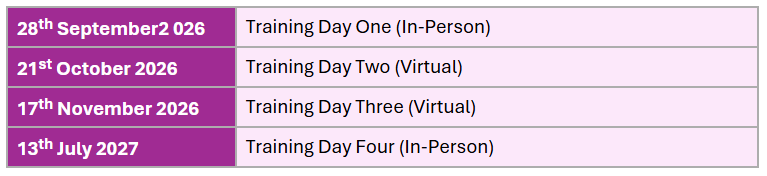
It is planned that the core training days will be delivered in a mix of in-person days and virtual days, the below list is the planned dates along with delivery method. It is planned that the in-person dates will be held within Bristol, applicants who would need to travel to these days should factor this into their finance plan for the internship.
Q: What are the expected outputs of the awards?
Expected outputs will vary depending on which theme the intern is working under. Examples from previous interns include:
- Developing research culture initiatives (e.g., research boards, journal clubs)
- Producing a protocol for a scoping review and completing PPIE activities (clinical academic pathway)
- Completing Master’s-level research training modules
Beyond these tangible outputs, a core focus of the programme is personal growth and development. There is no expectation that interns must progress to a doctoral pathway or clinical/practitioner academic career.
Instead, applications should demonstrate how the internship will support the intern’s:
- Personal development
- Professional growth
- Increased awareness, confidence, and engagement with research
- Ability to bring research-informed thinking into their current role
Progress may take many forms, and development does not need to involve pursuing further academic study
Q: For the award outputs, are publications useful/essential?
The type of outputs will vary depending on which theme your work is aligned to. For the clinical/practitioner academic theme publications may be a useful output to illustrate how the project the body of work is building on a solid foundation i.e. protocol for a scoping review etc.
Q: Do you need to align yourself to one specific theme?
Ideally yes. Your work should focus on one theme predominantly, however, we recognise that there may be some overlap at times. We would recommend that you align yourself to one theme but add specific detail about the overlap within your application statements. In this situation it may be really useful to make contact with a partner organisation link roles to get support with your statements.
Q: Are you allocating awards equally across themes or will awards be made on application merit?
We have not planned a specific allocation at this stage. All applications will be scored using the same marking criteria (please see guidance notes). It is important for us however, to allocate across all themes to ensure development for as many people as possible.
Q: In relation to theme 3, what is difference between this scheme and the NIHR Pre-doctoral Clinical and Practitioner Academic Fellowship (PCAF) scheme?
This is an entry level award for HCP who are new to research with the aim of working across several themes. The PCAF awards are more closely aligned with a clinical academic pathway. NIHR like to see the progression in both the researcher’s capability and the project/topic of focus. The internship acts as a stepping stone to a PCAF level award and provides the time to plan for what the PCAF would look like. Often HCP applying under the clinical/practitioner academic theme will use Internship time to develop a review protocol (to be completed during a PCAF), to complete some PPIE activities to further inform the project and to build a network of supervisors ready for a future application.
Q: Can I cost in for a laptop?
No, costs related to laptop purchases will not be covered within this award. Research costs linked to your application may include equipment such as Dictaphones.
Q: Why is the minimum days set at 25 when this may not be needed to undertake the research for a smaller project?
The scope of the awards is to enhance research capacity and capability across the SW-Central region. Alongside individuals developing within the research pillar, we believe it is important to have time to build a research network and engage in peer discussion. If you feel that 25 days is too much for your specific application, we recommend you contacting a PO link or the core internship team.
Q: Are you able to apply for the next NIHR scheme if you are currently on an award?
Yes. This is very appropriate and recommended in many cases. Application timelines are always challenging to align perfectly. An appropriate output/activity within the awards would be to develop a future application. We have examples of clinicians using some of their time to apply for an NIHR PCAF or the NIHR Pre-Application Support Scheme.